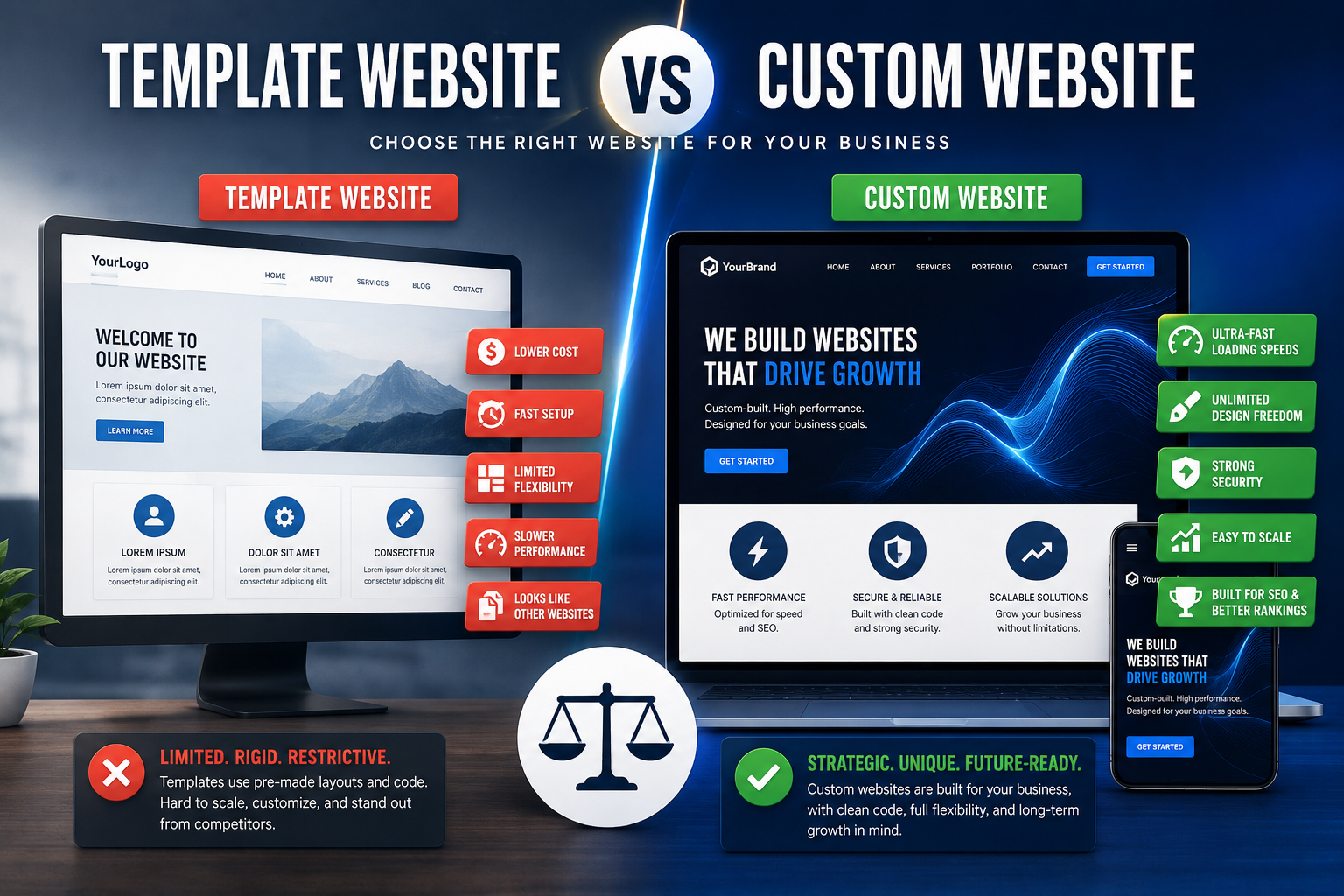
When building a website for your business, one of the first decisions you’ll face is whether to use a website template or invest in a custom built website.
At first glance, templates can seem like the obvious choice. They are inexpensive, quick to launch, and require little technical knowledge. However, as your business grows, the limitations of template based websites often become apparent.
A custom built website, on the other hand, is designed specifically for your business goals, customers, and long term growth strategy.
So which option is right for you?
Let’s break down the key differences between template websites and custom websites so you can make an informed decision.
What Is a Template Website?
A template website is built using a pre designed layout that allows users to replace placeholder content with their own text, images, and branding.
Popular platforms that offer template based websites include:
- WordPress themes
- Wix templates
- Squarespace templates
- Shopify themes
- Webflow templates
Templates are designed to help businesses get online quickly without the cost of custom development.
While this sounds appealing, there are important trade-offs to consider.
Advantages of Template Websites
Lower Initial Cost
The biggest advantage of a template website is affordability.
Many templates are free or available for a relatively small one time fee.
For startups and hobby projects with limited budgets, this can be an attractive option.
Faster Launch Time
Because much of the design work has already been completed, template websites can often be launched within days rather than weeks.
Businesses that need an online presence quickly may find this beneficial.
Beginner Friendly
Most website builders offer drag and drop editors that make it easy for non-technical users to create pages and update content.
No coding knowledge is required.
Disadvantages of Template Websites
Limited Design Flexibility
Although templates allow for some customization, they are ultimately built around a fixed structure.
This means:
- Your website may look similar to competitors using the same theme.
- Certain layouts cannot be changed easily.
- Unique branding opportunities may be limited.
Your business ends up adapting to the template instead of the template adapting to your business.
Slower Performance
Many templates are built to support hundreds of different features and use cases.
As a result, they often contain large amounts of unnecessary code.
This can lead to:
- Slower page load times
- Reduced mobile performance
- Lower Core Web Vitals scores
- Poor user experience
Website speed is a critical ranking factor and directly impacts conversion rates.
Difficult to Scale
As your business grows, you may want advanced functionality such as:
- Custom booking systems
- Client portals
- Membership platforms
- Advanced e-commerce features
- API integrations
Adding these features to a template website can become expensive, complicated, or impossible depending on the platform.
Security Risks
Templates often rely on multiple third party plugins and extensions.
Each additional plugin creates another potential vulnerability that hackers may exploit.
Poorly maintained themes can also become security liabilities over time.
What Is a Custom Built Website?
A custom-built website is developed specifically for your business from the ground up.
Instead of working within the limitations of an existing template, developers design and build every component around your goals, branding, and customer experience.
The result is a website that is uniquely yours.
Advantages of Custom Websites
Complete Design Freedom
With a custom website, every element is tailored to your business.
You can create:
- Unique layouts
- Custom animations
- Personalized customer journeys
- Industry specific functionality
- Distinctive branding experiences
Your website becomes a competitive advantage rather than a copy of hundreds of other sites online.
Superior Performance
Custom websites are built using clean, optimized code.
Because developers only include the features your business actually needs, the website remains lightweight and efficient.
Benefits include:
- Faster loading speeds
- Better mobile performance
- Improved user experience
- Higher conversion rates
Visitors are more likely to stay on a website that loads quickly and feels responsive.
Better SEO Performance
Search engines reward websites that provide a fast, accessible, and user-friendly experience.
Custom websites often outperform templates because they can be optimized from the ground up for:
- Technical SEO
- Page speed
- Mobile responsiveness
- Structured data
- Core Web Vitals
These factors contribute to stronger search engine rankings over time.
Scalability for Growth
A custom website grows with your business.
Whether you need:
- New service pages
- Online payment systems
- Customer dashboards
- Booking platforms
- CRM integrations
- Advanced automation
A custom framework provides the flexibility to expand without rebuilding your entire website.
Enhanced Security
Custom websites typically have fewer dependencies and unnecessary plugins.
This reduces attack surfaces and allows developers to implement stronger security practices tailored to your needs.
Disadvantages of Custom Websites
Higher Upfront Investment
Custom development requires professional design, planning, coding, testing, and optimization.
As a result, the initial cost is higher than purchasing a pre-made template.
However, many businesses view this as a long term investment rather than an expense.
Longer Development Timeline
Unlike templates that can be launched quickly, custom websites require time for:
- Strategy
- Design
- Development
- Testing
- Optimization
Depending on complexity, projects may take several weeks or months to complete.
Which Option Is Best for Your Business?
Choose a Template Website If:
- You are launching a personal project.
- You need a simple online presence.
- Your budget is extremely limited.
- You don’t expect significant growth.
- You need a website immediately.
Choose a Custom Website If:
- Your website generates leads or sales.
- You rely on Google search traffic.
- You want a unique brand identity.
- Performance and speed matter.
- You need advanced functionality.
- You plan to grow your business over time.
For most established businesses, a custom website delivers significantly greater value in the long run.
Cost vs Value: Looking Beyond the Price Tag
Many business owners focus solely on the upfront cost when comparing templates and custom websites.
A better question is:
“What will this website help my business earn over the next five years?”
A slow website that loses customers every day can cost far more than a custom website that converts visitors into paying clients.
The cheapest solution is not always the most affordable in the long term.
Final Verdict.
Template websites are useful for hobby projects, temporary websites, and businesses operating on extremely tight budgets.
However, if your website plays an important role in generating leads, attracting customers, building trust, or driving online sales, a custom-built website is usually the smarter investment.
Custom websites offer superior speed, flexibility, scalability, branding opportunities, SEO performance, and long term value.
Your website should be one of your most powerful business assets not a limitation that holds your growth back.
Ready to build a website that is designed specifically for your business goals? Contact our team today to discuss a high performance custom website that helps your business stand out and grow online.
Leave a Reply