Category: website design

  • How to Build an E-Commerce Website in Uganda That Accepts Mobile Money Instantly: 14 Proven Steps.

    How to Build an E-Commerce Website in Uganda That Accepts Mobile Money Instantly: 14 Proven Steps.

    How to Build an E-Commerce Website in Uganda That Accepts Mobile Money Instantly.

    Uganda’s online shopping market is growing rapidly, and businesses that embrace digital commerce are gaining a significant competitive advantage. How to Build an E-Commerce Website in Uganda That Accepts Mobile Money Instantly is one of the most important questions local entrepreneurs are asking today because customers increasingly expect fast, convenient, and secure payment options.

    If you own a boutique in Kampala, a cosmetics business in Mukono, an electronics shop in Entebbe, or even a home-based startup, relying solely on WhatsApp and Instagram DMs can limit your growth. Orders get lost, customer information becomes difficult to track, and payment verification often requires manual follow-up.

    A professionally built e-commerce website changes everything. Customers can browse products, place orders, make payments instantly using MTN Mobile Money or Airtel Money, and receive confirmation automatically.

    This guide walks you through the exact process.


    Table of Contents

    1. Why Ugandan Businesses Need E-Commerce
    2. Benefits of Mobile Money Integration
    3. Choosing the Right E-Commerce Platform
    4. How to Build an E-Commerce Website in Uganda That Accepts Mobile Money Instantly
    5. Setting Up MTN Mobile Money Payments
    6. Setting Up Airtel Money Payments
    7. Configuring Delivery Zones
    8. Common E-Commerce Mistakes
    9. Expert Tips for Growing Online Sales
    10. Frequently Asked Questions
    11. Conclusion

    Why Ugandan Businesses Need E-Commerce

    The way Ugandans shop has changed dramatically over the last few years.

    Consumers now search online before making purchasing decisions. Whether someone is buying clothing, electronics, beauty products, groceries, or household items, they want convenience.

    Many local businesses still operate through:

    • WhatsApp orders
    • Facebook Marketplace
    • Instagram DMs
    • Phone calls

    While these methods work initially, they create several challenges:

    Lost Customer Orders

    Messages can easily be buried among hundreds of conversations.

    Manual Payment Verification

    Business owners spend valuable time checking Mobile Money transactions individually.

    Lack of Professional Trust

    Modern consumers trust businesses that have professional websites more than businesses that rely entirely on social media.

    Poor Inventory Tracking

    Manual systems often lead to overselling products that are already out of stock.

    An e-commerce website solves these issues by centralizing your entire sales process.


    Benefits of Mobile Money Integration for Ugandan Online Stores

    One major reason online businesses fail is offering payment methods customers do not use.

    In Uganda, Mobile Money dominates digital transactions.

    Customers Can Pay Instantly

    Customers complete purchases without contacting your team.

    The entire process happens automatically.

    Higher Conversion Rates

    When customers can pay using familiar services like MTN Mobile Money and Airtel Money, they are more likely to complete purchases.

    Reduced Administrative Work

    Automated payment verification saves hours every week.

    Better Customer Experience

    Customers appreciate fast, seamless checkout experiences.

    Increased Trust

    Secure payment gateways make customers feel comfortable buying online.


    How to Build an E-Commerce Website in Uganda That Accepts Mobile Money Instantly

    Building an online store requires more than simply creating a website.

    You need a complete digital sales system.

    Step 1: Register a Domain Name

    Choose a memorable domain that reflects your business.

    Examples:

    • yourshop.ug
    • yourbrand.com
    • yourbusiness.co.ug

    Keep it short, professional, and easy to remember.

    Step 2: Purchase Reliable Hosting

    Your hosting provider affects:

    • Website speed
    • Security
    • Uptime
    • Customer experience

    Fast websites convert significantly better than slow websites.

    Step 3: Select an E-Commerce Platform

    Popular choices include:

    • WooCommerce
    • Shopify
    • Magento
    • OpenCart

    For many Ugandan businesses, WooCommerce offers flexibility and affordability.

    Step 4: Design a Professional Store

    Your design should include:

    • Mobile responsiveness
    • Product categories
    • Search functionality
    • Clear navigation
    • Professional branding

    Remember that most Ugandan shoppers browse using smartphones.


    How to Build an E-Commerce Website in Uganda That Accepts Mobile Money Instantly With Local Payments

    The next step is integrating local payment solutions.

    This is where your store becomes truly useful for Ugandan shoppers.

    MTN Mobile Money Integration

    MTN Mobile Money remains one of the most widely used payment methods in Uganda.

    Benefits include:

    • Instant transactions
    • Wide customer adoption
    • Secure payment processing
    • Real-time payment confirmation

    When integrated properly, customers simply enter their phone number and approve payment directly on their mobile device.

    Airtel Money Integration

    Airtel Money provides another essential payment option.

    Offering both payment methods increases accessibility and reduces cart abandonment.

    Customers prefer having multiple payment choices.


    Choosing a Payment Gateway for Uganda

    Most businesses connect Mobile Money through payment gateways.

    A gateway acts as the bridge between your website and Mobile Money networks.

    Features to look for include:

    Security

    Protect customer information and payment data.

    Automatic Confirmation

    Orders should update automatically after successful payment.

    Easy Integration

    The gateway should work seamlessly with your e-commerce platform.

    Reporting Features

    Track revenue, orders, and customer activity.


    Configuring Delivery Zones for Kampala, Entebbe, and Mukono

    Shipping setup is often overlooked.

    However, it significantly affects customer satisfaction.

    Kampala Deliveries

    Offer:

    • Same-day delivery
    • Next-day delivery
    • Express delivery

    Entebbe Deliveries

    Clearly define:

    • Delivery fees
    • Expected delivery times
    • Pickup options

    Mukono Deliveries

    Create separate shipping zones for accurate pricing.

    Customers appreciate transparency before checkout.


    Common Mistakes Businesses Make

    Ignoring Mobile Optimization

    Most Ugandan shoppers browse from smartphones.

    A poor mobile experience hurts conversions.

    Complicated Checkout Processes

    Keep checkout simple.

    Every extra step reduces completed purchases.

    Limited Payment Options

    Offering only one payment method excludes potential customers.

    Poor Product Images

    Professional photos improve trust and increase sales.

    Slow Website Performance

    Even a few seconds of delay can cause customers to leave.


    Expert Tips to Increase E-Commerce Sales

    Businesses that succeed online focus on continuous improvement.

    Invest in SEO

    Search engine optimization helps customers find your store organically.

    Use High-Quality Product Photography

    Professional images significantly improve conversion rates.

    Collect Customer Reviews

    Reviews build trust and credibility.

    Automate Customer Notifications

    Send:

    • Order confirmations
    • Shipping updates
    • Delivery confirmations

    Analyse Website Data

    Monitor:

    • Visitor behaviour
    • Product performance
    • Checkout abandonment rates

    Data-driven decisions lead to faster growth.


    Real-World Example

    Imagine a fashion boutique in Kampala receiving 50 customer inquiries daily through Instagram.

    The owner manually responds to messages, confirms payments, and tracks deliveries.

    As sales increase, managing everything becomes overwhelming.

    After launching a dedicated e-commerce website with Mobile Money integration:

    • Orders become automated
    • Payments are verified instantly
    • Inventory updates automatically
    • Customer satisfaction improves
    • Sales scale more efficiently

    This is why more Ugandan businesses are investing in professional online stores.


    Internal Link Opportunities

    • Professional Web Design Services
    • E-Commerce Development Services
    • Mobile App Development
    • SEO Services
    • Digital Marketing Services

    External Resources

    • Google Search Central
    • Google Analytics Documentation
    • Uganda Communications Commission
    • MTN Mobile Money Business Resources
    • Airtel Money Merchant Resources


    Frequently Asked Questions

    How much does it cost to build an e-commerce website in Uganda?

    Costs vary depending on features, design requirements, and payment integrations. Small businesses can start with affordable solutions and scale over time.

    Can I accept MTN Mobile Money payments on my website?

    Yes. By integrating a supported payment gateway, customers can pay directly through MTN Mobile Money.

    Can I integrate Airtel Money into my online store?

    Absolutely. Many payment providers support Airtel Money integrations.

    How long does it take to build an e-commerce website in Uganda?

    Most projects take between one and four weeks depending on complexity.

    Is Mobile Money secure for online payments?

    Yes. When implemented through reputable payment gateways, Mobile Money payments are secure and reliable.

    What platform is best for Ugandan online stores?

    WooCommerce is often preferred because it offers flexibility, affordability, and strong integration capabilities.

    Do I need technical skills to run an online store?

    Not necessarily. Most modern e-commerce systems are user-friendly and can be managed without advanced technical knowledge.


    Conclusion

    Understanding How to Build an E-Commerce Website in Uganda That Accepts Mobile Money Instantly is essential for businesses looking to compete in today’s digital marketplace. By combining a professional website, secure MTN Mobile Money and Airtel Money integrations, optimized delivery zones, and a customer-focused shopping experience, Ugandan businesses can automate operations, increase sales, and build stronger relationships with customers.

    The businesses that invest in e-commerce today are positioning themselves for long-term growth tomorrow.

  • Why Is Cheap Shared Hosting Making My Business Website Load So Slowly?

    Why Is Cheap Shared Hosting Making My Business Website Load So Slowly?

    Your website might look professional, have great content, and offer excellent products or services—but if it’s hosted on cheap shared hosting, visitors may never stick around long enough to see any of it.

    Website speed has become one of the most important factors affecting user experience, search engine rankings, lead generation, and online sales. Yet many business owners unknowingly sabotage their website’s performance by choosing the cheapest hosting plan available.

    If your website takes several seconds to load, experiences random slowdowns, or occasionally becomes unavailable, your hosting provider could be the root cause.

    Let’s explore why cheap shared hosting slows websites down and what you can do to fix it.

    What Is Shared Hosting?

    Shared hosting is a hosting environment where hundreds—or even thousands—of websites share the same server resources.

    Instead of having dedicated processing power, memory, and storage, all websites on the server compete for the same pool of resources.

    Hosting companies offer these plans at very low prices because the costs are spread across many customers.

    While shared hosting may be suitable for small personal websites or hobby projects, it often struggles to meet the demands of a growing business website.

    Why Shared Hosting Causes Slow Website Performance

    Imagine running a business in a building where thousands of other businesses share the same electricity, water supply, and internet connection.

    Everything works fine until one tenant suddenly starts consuming most of the resources.

    The same thing happens with shared hosting.

    When other websites on the server demand more resources, your website is left fighting for what’s available.

    The result?

    • Slow page loading times
    • Delayed server responses
    • Website downtime
    • Poor user experience

    Let’s look at the biggest reasons this happens.

    1. Bad Neighbor Syndrome

    One of the most common problems with shared hosting is known as “Bad Neighbor Syndrome.”

    Because your website shares a server with many others, the behavior of neighboring websites can directly affect your performance.

    For example, if another website on the server:

    • Experiences a sudden traffic spike
    • Runs poorly optimized software
    • Gets infected with malware
    • Sends large amounts of spam emails
    • Uses excessive server resources

    Your website may become slower even though nothing has changed on your end.

    This means your business performance is partially dependent on the actions of strangers you don’t know.

    The Hidden Risk

    In severe cases, a compromised website on the same server can even impact:

    • Security
    • Email deliverability
    • Server reputation
    • Uptime reliability

    This creates risks that many business owners never realize exist.

    2. Poor User Experience Drives Visitors Away

    Modern internet users are impatient.

    Research consistently shows that visitors expect websites to load within just a few seconds.

    When a page takes too long to load, people don’t wait.

    They leave.

    Potential customers may:

    • Abandon your website
    • Visit a competitor
    • Lose confidence in your business
    • Never return

    Even a small delay can significantly reduce conversions.

    What Visitors Expect Today

    Users generally expect:

    • Instant navigation
    • Fast page loads
    • Smooth mobile experiences
    • Reliable performance

    A slow website creates frustration and damages trust before customers even engage with your products or services.

    Slow Websites Lose Sales

    Consider the customer journey:

    A visitor clicks your website from Google.

    Your page begins loading.

    Three seconds pass.

    Five seconds pass.

    The page still isn’t ready.

    Most users simply hit the back button and choose another business.

    That lost visitor may have become a paying customer if your website loaded quickly.

    3. Google Uses Speed as a Ranking Factor

    Website speed doesn’t just affect visitors.

    It also affects how search engines evaluate your website.

    Google has publicly confirmed that page speed and user experience metrics influence search rankings.

    A slow website can negatively impact:

    • Search visibility
    • Organic traffic
    • Mobile rankings
    • Core Web Vitals scores
    • Crawl efficiency

    If your competitors have faster websites, Google may prioritize their pages above yours in search results.

    Core Web Vitals Matter

    Google’s Core Web Vitals measure:

    • Loading performance
    • Visual stability
    • User interaction responsiveness

    Cheap hosting often struggles to meet these performance benchmarks because the server itself is overloaded.

    Even excellent content can struggle to rank when the underlying infrastructure is slow.

    4. Server Response Times Are Often Terrible

    One overlooked metric is server response time.

    Before a webpage even begins loading, the server must respond to the visitor’s request.

    Budget hosting providers frequently overload servers to maximize profits.

    As a result:

    • Requests take longer to process
    • Database queries become slower
    • Dynamic pages lag
    • Overall website responsiveness suffers

    A slow server creates delays before your website content even starts appearing.

    5. Downtime Can Cost Your Business Money

    Cheap hosting plans often experience more outages and interruptions.

    When your website goes offline:

    • Customers cannot contact you
    • Leads are lost
    • Sales opportunities disappear
    • Search engines may encounter crawl errors

    Even brief periods of downtime can impact revenue and customer trust.

    For businesses that depend on their website, reliability is just as important as speed.

    What Is the Solution?

    The best solution is upgrading to premium hosting that provides dedicated or guaranteed resources.

    This can include:

    Managed Cloud Hosting

    Cloud hosting distributes resources across multiple servers.

    Benefits include:

    • Faster performance
    • Better reliability
    • Improved scalability
    • Enhanced uptime

    Managed WordPress Hosting

    Designed specifically for WordPress websites.

    Benefits include:

    • Server-level optimization
    • Automatic updates
    • Enhanced security
    • Better caching systems

    Virtual Private Servers (VPS)

    A VPS provides dedicated portions of server resources rather than sharing everything equally.

    Benefits include:

    • Greater control
    • Improved performance
    • Better resource allocation

    Dedicated Servers

    For high-traffic websites, dedicated servers provide maximum performance by allocating an entire server to a single business.

    Benefits of Upgrading Your Hosting

    Businesses often notice immediate improvements after moving away from cheap shared hosting.

    Common benefits include:

    • Faster page load speeds
    • Better Google rankings
    • Higher conversion rates
    • Improved customer experience
    • Increased website stability
    • Stronger security
    • Reduced downtime

    For many businesses, upgrading hosting delivers one of the highest returns on investment among all website improvements.

    Is Cheap Hosting Ever Worth It?

    Cheap shared hosting can work for:

    • Personal blogs
    • Small hobby websites
    • Temporary projects
    • Websites with very little traffic

    However, if your website generates leads, sales, bookings, or customer inquiries, relying on bargain hosting can ultimately cost more than it saves.

    Final Thoughts

    Your website’s performance is only as strong as the server powering it.

    Cheap shared hosting may save a few dollars each month, but it often leads to slower load times, lower search rankings, frustrated visitors, and lost revenue.

    If your business depends on its online presence, investing in high-quality hosting is one of the smartest decisions you can make.

    A fast website creates a better user experience, improves SEO performance, increases conversions, and helps your business compete effectively online.

    Don’t let a slow server drive potential customers away. Upgrade to reliable, high-performance hosting and give your website the foundation it needs to succeed.

  • Template Website vs Custom Website: Which One Is Right for Your Business?

    Template Website vs Custom Website: Which One Is Right for Your Business?

    When building a website for your business, one of the first decisions you’ll face is whether to use a website template or invest in a custom built website.

    At first glance, templates can seem like the obvious choice. They are inexpensive, quick to launch, and require little technical knowledge. However, as your business grows, the limitations of template based websites often become apparent.

    A custom built website, on the other hand, is designed specifically for your business goals, customers, and long term growth strategy.

    So which option is right for you?

    Let’s break down the key differences between template websites and custom websites so you can make an informed decision.

    What Is a Template Website?

    A template website is built using a pre designed layout that allows users to replace placeholder content with their own text, images, and branding.

    Popular platforms that offer template based websites include:

    • WordPress themes
    • Wix templates
    • Squarespace templates
    • Shopify themes
    • Webflow templates

    Templates are designed to help businesses get online quickly without the cost of custom development.

    While this sounds appealing, there are important trade-offs to consider.

    Advantages of Template Websites

    Lower Initial Cost

    The biggest advantage of a template website is affordability.

    Many templates are free or available for a relatively small one time fee.

    For startups and hobby projects with limited budgets, this can be an attractive option.

    Faster Launch Time

    Because much of the design work has already been completed, template websites can often be launched within days rather than weeks.

    Businesses that need an online presence quickly may find this beneficial.

    Beginner Friendly

    Most website builders offer drag and drop editors that make it easy for non-technical users to create pages and update content.

    No coding knowledge is required.

    Disadvantages of Template Websites

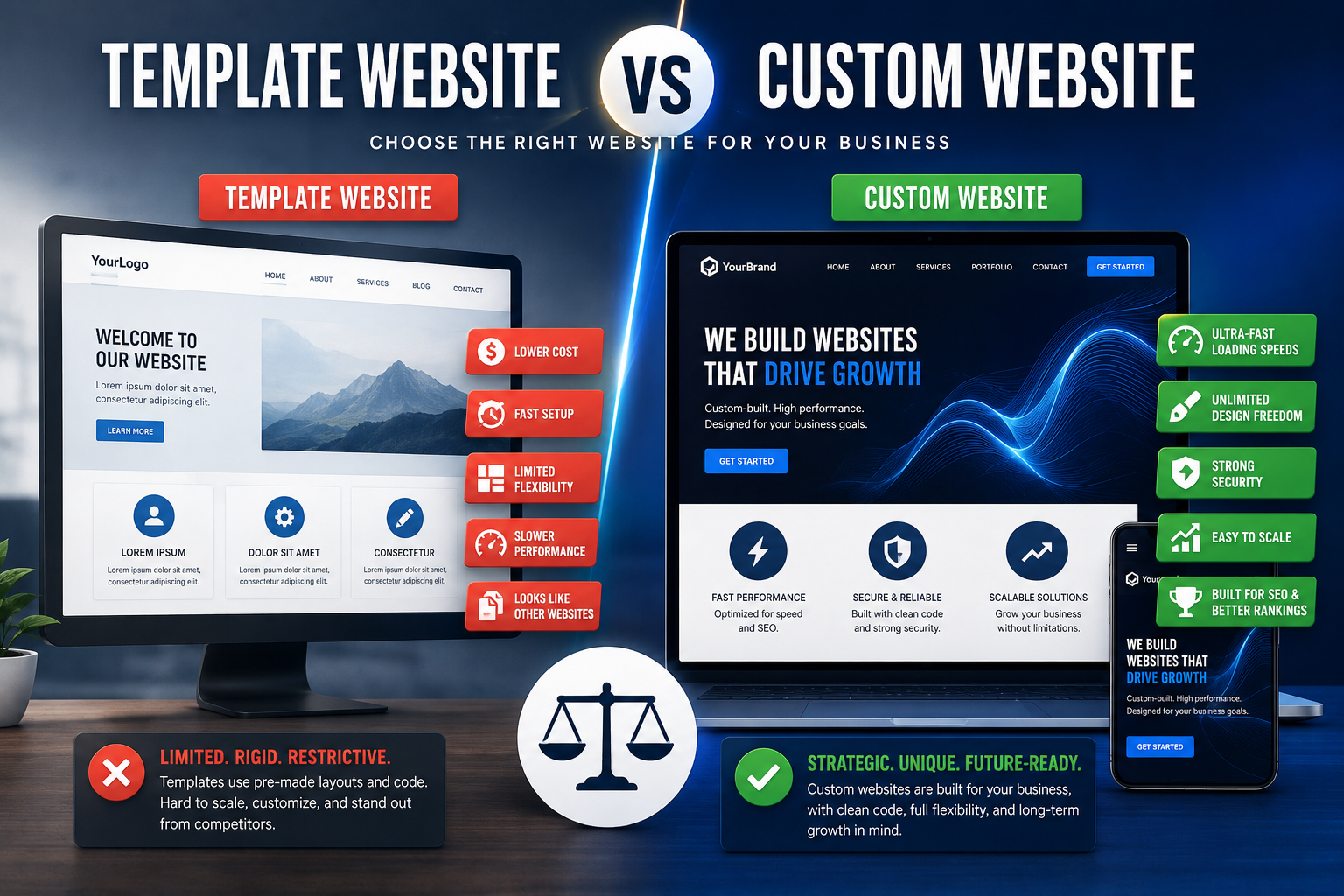
    Limited Design Flexibility

    Although templates allow for some customization, they are ultimately built around a fixed structure.

    This means:

    • Your website may look similar to competitors using the same theme.
    • Certain layouts cannot be changed easily.
    • Unique branding opportunities may be limited.

    Your business ends up adapting to the template instead of the template adapting to your business.

    Slower Performance

    Many templates are built to support hundreds of different features and use cases.

    As a result, they often contain large amounts of unnecessary code.

    This can lead to:

    • Slower page load times
    • Reduced mobile performance
    • Lower Core Web Vitals scores
    • Poor user experience

    Website speed is a critical ranking factor and directly impacts conversion rates.

    Difficult to Scale

    As your business grows, you may want advanced functionality such as:

    • Custom booking systems
    • Client portals
    • Membership platforms
    • Advanced e-commerce features
    • API integrations

    Adding these features to a template website can become expensive, complicated, or impossible depending on the platform.

    Security Risks

    Templates often rely on multiple third party plugins and extensions.

    Each additional plugin creates another potential vulnerability that hackers may exploit.

    Poorly maintained themes can also become security liabilities over time.

    What Is a Custom Built Website?

    A custom-built website is developed specifically for your business from the ground up.

    Instead of working within the limitations of an existing template, developers design and build every component around your goals, branding, and customer experience.

    The result is a website that is uniquely yours.

    Advantages of Custom Websites

    Complete Design Freedom

    With a custom website, every element is tailored to your business.

    You can create:

    • Unique layouts
    • Custom animations
    • Personalized customer journeys
    • Industry specific functionality
    • Distinctive branding experiences

    Your website becomes a competitive advantage rather than a copy of hundreds of other sites online.

    Superior Performance

    Custom websites are built using clean, optimized code.

    Because developers only include the features your business actually needs, the website remains lightweight and efficient.

    Benefits include:

    • Faster loading speeds
    • Better mobile performance
    • Improved user experience
    • Higher conversion rates

    Visitors are more likely to stay on a website that loads quickly and feels responsive.

    Better SEO Performance

    Search engines reward websites that provide a fast, accessible, and user-friendly experience.

    Custom websites often outperform templates because they can be optimized from the ground up for:

    • Technical SEO
    • Page speed
    • Mobile responsiveness
    • Structured data
    • Core Web Vitals

    These factors contribute to stronger search engine rankings over time.

    Scalability for Growth

    A custom website grows with your business.

    Whether you need:

    • New service pages
    • Online payment systems
    • Customer dashboards
    • Booking platforms
    • CRM integrations
    • Advanced automation

    A custom framework provides the flexibility to expand without rebuilding your entire website.

    Enhanced Security

    Custom websites typically have fewer dependencies and unnecessary plugins.

    This reduces attack surfaces and allows developers to implement stronger security practices tailored to your needs.

    Disadvantages of Custom Websites

    Higher Upfront Investment

    Custom development requires professional design, planning, coding, testing, and optimization.

    As a result, the initial cost is higher than purchasing a pre-made template.

    However, many businesses view this as a long term investment rather than an expense.

    Longer Development Timeline

    Unlike templates that can be launched quickly, custom websites require time for:

    • Strategy
    • Design
    • Development
    • Testing
    • Optimization

    Depending on complexity, projects may take several weeks or months to complete.

    Which Option Is Best for Your Business?

    Choose a Template Website If:

    • You are launching a personal project.
    • You need a simple online presence.
    • Your budget is extremely limited.
    • You don’t expect significant growth.
    • You need a website immediately.

    Choose a Custom Website If:

    • Your website generates leads or sales.
    • You rely on Google search traffic.
    • You want a unique brand identity.
    • Performance and speed matter.
    • You need advanced functionality.
    • You plan to grow your business over time.

    For most established businesses, a custom website delivers significantly greater value in the long run.

    Cost vs Value: Looking Beyond the Price Tag

    Many business owners focus solely on the upfront cost when comparing templates and custom websites.

    A better question is:

    “What will this website help my business earn over the next five years?”

    A slow website that loses customers every day can cost far more than a custom website that converts visitors into paying clients.

    The cheapest solution is not always the most affordable in the long term.

    Final Verdict.

    Template websites are useful for hobby projects, temporary websites, and businesses operating on extremely tight budgets.

    However, if your website plays an important role in generating leads, attracting customers, building trust, or driving online sales, a custom-built website is usually the smarter investment.

    Custom websites offer superior speed, flexibility, scalability, branding opportunities, SEO performance, and long term value.

    Your website should be one of your most powerful business assets not a limitation that holds your growth back.

    Ready to build a website that is designed specifically for your business goals? Contact our team today to discuss a high performance custom website that helps your business stand out and grow online.

  • What Should I Do If the .com Domain Name I Want Is Already Taken?

    What Should I Do If the .com Domain Name I Want Is Already Taken?

    Finding the perfect domain name for your business can feel exciting until you discover that the .com version is already registered.

    Many entrepreneurs assume this means they need to completely rebrand or settle for a poor alternative. Fortunately, that is not the case.

    The reality is that thousands of successful businesses operate without owning their exact .com domain. With the right strategy, you can still build a memorable brand, rank well on Google, and create a professional online presence.

    In this guide, we’ll explore the best options available when your preferred .com domain name is already taken.

    Why Are So Many .com Domains Already Registered?

    The .com extension has been around since the early days of the internet and remains the most recognized domain extension worldwide.

    Because of its popularity:

    • Millions of domain names have already been registered.
    • Many domains are owned by businesses actively using them.
    • Some domains are held by investors who buy and resell valuable names.
    • Others are reserved for future projects and may not currently display a website.

    As a result, finding a short, brandable .com domain has become increasingly difficult.

    However, a taken .com domain does not mean your branding journey is over.

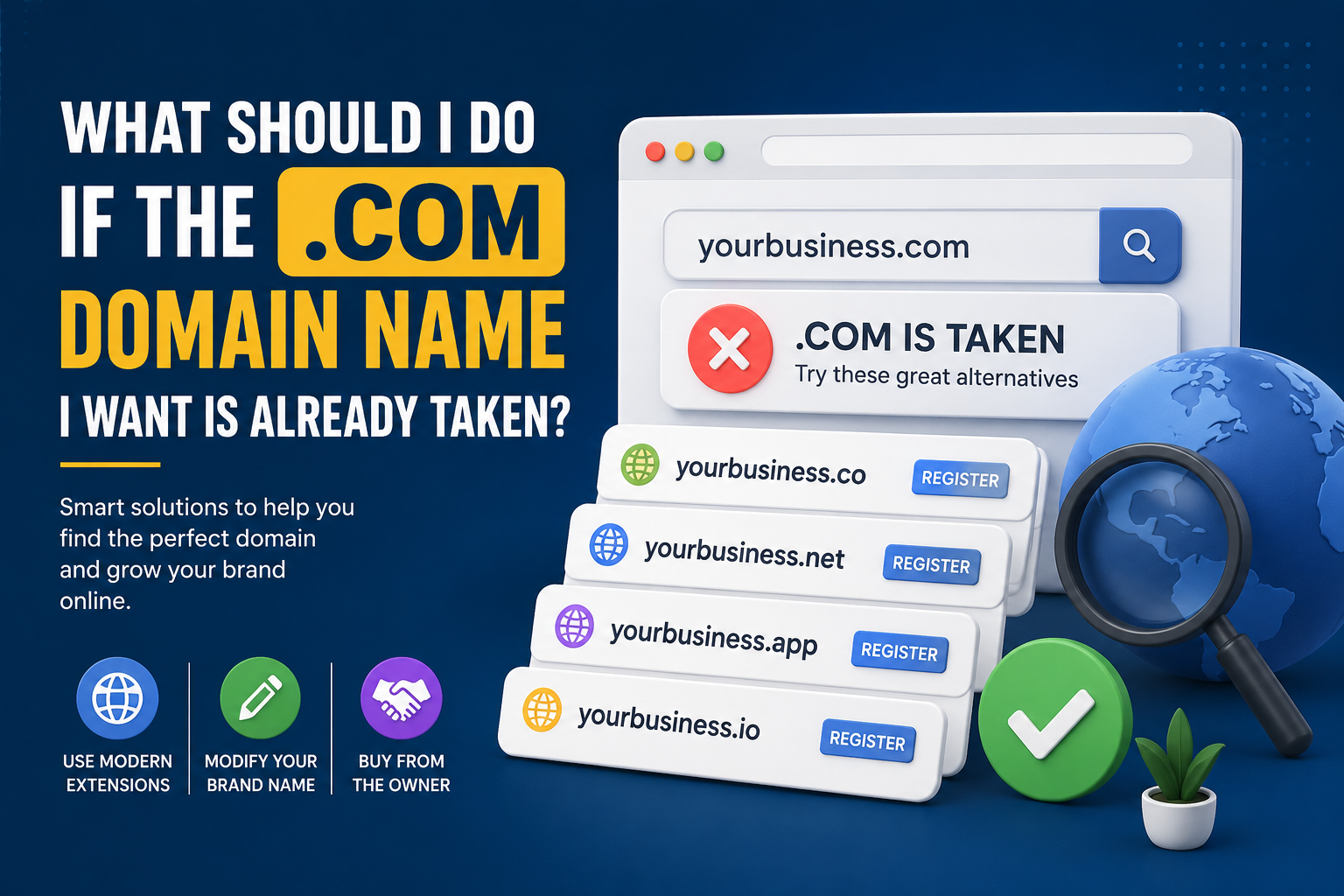
    Option 1: Use a Modern Domain Extension

    One of the easiest and most effective solutions is choosing a modern top level domain (TLD).

    Today’s internet users are far more familiar with alternative extensions than they were a decade ago. Search engines such as Google also treat these extensions similarly to .com when evaluating websites.

    Best Alternatives to .com

    .co

    Perfect for startups, agencies, freelancers, and modern businesses.

    Examples:

    • yourbrand.co
    • growthstudio.co
    • creativehub.co

    .net

    A trusted alternative that has existed for decades.

    Ideal for:

    • Technology companies
    • Service providers
    • Online platforms

    Examples:

    • yourbrand.net
    • websolutions.net

    .app

    Excellent for mobile apps and software companies.

    Examples:

    • yourbrand.app
    • fitnesstracker.app
    • productivity.app

    .io

    Popular among technology startups and software products.

    Examples:

    • yourbrand.io
    • analytics.io

    Country Specific Domains

    If your customers are primarily local, a country code domain can be a smart choice.

    Examples:

    • yourbrand.ug
    • yourbrand.ke
    • yourbrand.co.uk

    These domains can help reinforce local trust and relevance.

    Do Alternative Extensions Hurt SEO?

    No.

    Google has repeatedly confirmed that modern domain extensions can rank just as well as .com domains.

    What matters most is:

    • Quality content
    • Website speed
    • User experience
    • Backlinks
    • Technical SEO

    Your extension alone will not prevent your website from ranking.

    Option 2: Modify Your Brand Name Strategically

    If your exact domain is unavailable, consider making a small adjustment while keeping your brand recognizable.

    The goal is to remain memorable without creating confusion.

    Add an Action Word

    Adding a short verb before your brand name is a common strategy used by many successful companies.

    Examples:

    • GetYourBrand.com
    • UseYourBrand.com
    • JoinYourBrand.com
    • TryYourBrand.com

    These variations are easy to remember and often feel more engaging.

    Add a Business Descriptor

    Another approach is to describe what your company does.

    Examples:

    • YourBrandShop.com
    • YourBrandStudio.com
    • YourBrandApps.com
    • YourBrandMedia.com
    • YourBrandDigital.com

    This can actually improve clarity for new visitors.

    Add a Location

    If your business serves a specific city or country, adding a location can be highly effective.

    Examples:

    • YourBrandUganda.com
    • YourBrandKampala.com
    • YourBrandAfrica.com

    This strategy works particularly well for local businesses, agencies, consultants, and service providers.

    Keep It Short

    When modifying your domain:

    ✅ Easy to spell

    ✅ Easy to pronounce

    ✅ Easy to remember

    ❌ Avoid numbers

    ❌ Avoid hyphens when possible

    ❌ Avoid long phrases

    The simpler the domain, the easier it is for customers to find you.

    Option 3: Purchase the Domain from the Current Owner

    Sometimes the domain owner may be willing to sell.

    Before contacting them, determine:

    • Whether the domain is actively being used
    • Whether it is parked for resale
    • Whether it belongs to a functioning business

    You can usually discover ownership information through a WHOIS lookup service or domain marketplace.

    Use a Domain Broker

    If the domain is important to your long term brand strategy, consider using a professional domain broker.

    A broker can:

    • Contact the owner anonymously
    • Negotiate on your behalf
    • Help determine fair market value
    • Handle the transfer process securely

    This is often the safest way to acquire premium domains.

    How Much Do Premium Domains Cost?

    Prices vary dramatically.

    A domain might cost:

    • $100 $500 for a simple resale
    • $1,000 $10,000 for desirable business names
    • Tens of thousands of dollars for premium keywords

    Before purchasing, evaluate whether the investment aligns with your business goals and budget.

    Option 4: Wait and Monitor the Domain

    Some registered domains eventually expire.

    If the current owner fails to renew it, the domain may become available again.

    You can use domain monitoring services to receive alerts if the domain status changes.

    This approach requires patience but can occasionally result in securing a valuable domain at a standard registration price.

    Common Mistakes to Avoid

    When your preferred .com is unavailable, avoid these common mistakes:

    Choosing a Complicated Alternative

    A difficult to spell domain creates unnecessary friction for customers.

    Copying Another Brand Too Closely

    Avoid creating a domain that could cause trademark conflicts or customer confusion.

    Ignoring Social Media Availability

    Before finalizing a domain, check whether matching social media usernames are available.

    Consistent branding across platforms makes marketing easier.

    Overpaying Without Research

    Not every domain is worth thousands of dollars.

    Always evaluate the business value before making a large purchase.

    The Bottom Line

    If your ideal .com domain name is already taken, you still have several excellent options.

    You can:

    1. Choose a modern extension such as .co, .net, .app, or .io.
    2. Modify your brand name with a descriptive word or location.
    3. Purchase the domain through a broker or direct negotiation.
    4. Monitor the domain in case it becomes available in the future.

    The most important thing is not the extension itself it’s building a strong brand, providing value to your customers, and creating a website that people trust.

    Many successful companies started with alternative domains and grew into globally recognized brands. With the right strategy, your business can do the same.

  • Why Your Business Needs a Professional Website in 2026?

    Why Your Business Needs a Professional Website in 2026?

    Introduction

    In today’s digital-first world, a professional website is no longer optional — it’s a business necessity. For most businesses, your website is the first impression your potential customers will have. A professional, well-designed website not only showcases your products or services but also establishes trust, credibility, and authority in your industry.

    Whether you are a startup, small business, or growing enterprise, understanding the professional website benefits can help you make smarter decisions that drive traffic, leads, and revenue.


    1. First Impressions Matter: Professional Website Benefits

    A professional website creates a strong first impression. Studies show that users judge businesses within seconds of visiting a website. With a modern, clean design:

    • Visitors instantly perceive your brand as trustworthy
    • They are more likely to explore your services
    • Bounce rates decrease, keeping users engaged

    Pro Tip: Ensure your homepage clearly communicates your brand’s purpose and primary offerings in under 5 seconds.

    Suggested Image:

    • Comparison of a basic website vs. a professional website
    • Alt text: “First impression: amateur vs professional website”


    2. Reach a Global Audience

    Unlike physical stores, a website is accessible 24/7 from anywhere in the world. One of the biggest professional website benefits is its ability to expand your reach beyond local customers. A professional website allows you to:

    • Showcase services or products to a wider audience
    • Generate leads from remote clients
    • Maintain a competitive edge in your industry

    Suggested Image:

    • Globe with digital connections showing global reach
    • Alt text: “Global reach of a professional business website”

    3. Build Credibility and Trust

    Customers are more likely to trust businesses with a professional website. Features that improve credibility include:

    • Clean, user-friendly navigation
    • Clear service descriptions
    • Testimonials and portfolio sections

    A website that reflects professionalism instills confidence in your brand and encourages repeat visits.


    4. Boost Sales and Conversions

    A professional website is not just about looks — it directly impacts revenue. By implementing strategic calls-to-action (CTAs) and optimized layouts, your website can:

    • Make it easier for users to purchase products or request services
    • Capture leads through contact forms
    • Track conversions and improve marketing strategies

    Internal Link Example: Learn how we help businesses grow with our web design services.


    5. Stay Ahead of Competitors

    Many businesses still rely on social media or word-of-mouth. One major professional website benefit is outperforming competitors who lack a polished online presence. A modern website helps you:

    • Rank higher on search engines with SEO-friendly design
    • Establish authority in your niche
    • Provide better user experience than competitors

    6. Gain Analytics and Customer Insights

    Professional websites allow you to track visitor behavior and engagement through analytics tools. Understanding your users helps you:

    • Identify popular products or services
    • Measure marketing campaign effectiveness
    • Make data-driven business decisions

    7. Integrate Marketing Efforts

    A professional website acts as the hub for all digital marketing strategies:

    • SEO to attract organic traffic
    • Social media integration to engage audiences
    • Email marketing campaigns to nurture leads

    By centralizing marketing on your website, you maximize ROI and ensure consistent brand messaging.

    Suggested Image:

    • Marketing funnel pointing to a website
    • Alt text: “Website as central hub for marketing campaigns”

    Conclusion: Invest in Your Online Presence

    The professional website benefits are clear: credibility, traffic, leads, and revenue. A professional website is your brand’s 24/7 ambassador, helping your business grow sustainably.

    Investing in a web design agency ensures your website is modern, optimized, and tailored to your target audience. Don’t let competitors get ahead — start building your professional online presence today!

    CTA:

    Contact us now to design a professional website that drives results for your business.