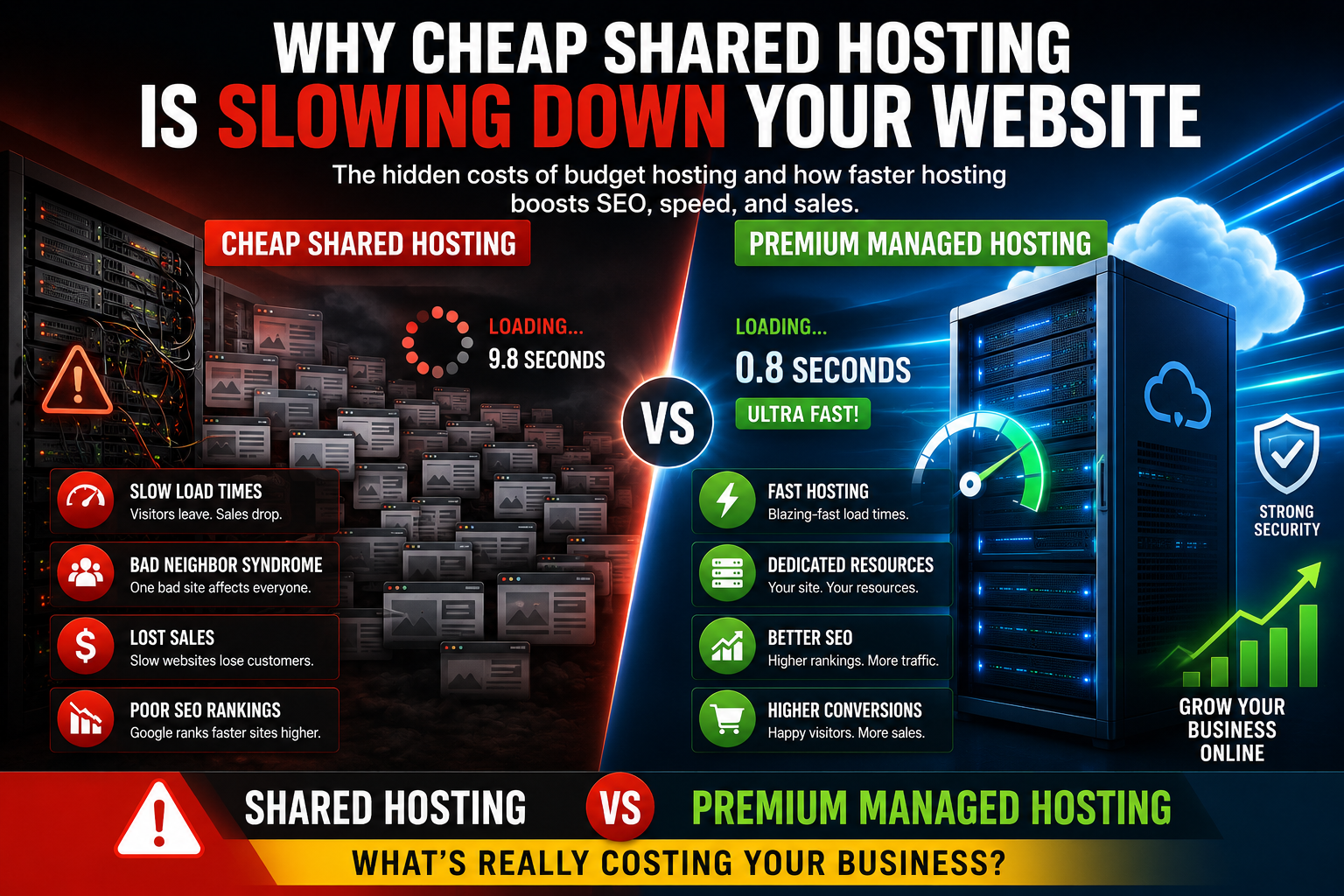
Your website might look professional, have great content, and offer excellent products or services—but if it’s hosted on cheap shared hosting, visitors may never stick around long enough to see any of it.
Website speed has become one of the most important factors affecting user experience, search engine rankings, lead generation, and online sales. Yet many business owners unknowingly sabotage their website’s performance by choosing the cheapest hosting plan available.
If your website takes several seconds to load, experiences random slowdowns, or occasionally becomes unavailable, your hosting provider could be the root cause.
Let’s explore why cheap shared hosting slows websites down and what you can do to fix it.
What Is Shared Hosting?
Shared hosting is a hosting environment where hundreds—or even thousands—of websites share the same server resources.
Instead of having dedicated processing power, memory, and storage, all websites on the server compete for the same pool of resources.
Hosting companies offer these plans at very low prices because the costs are spread across many customers.
While shared hosting may be suitable for small personal websites or hobby projects, it often struggles to meet the demands of a growing business website.
Why Shared Hosting Causes Slow Website Performance
Imagine running a business in a building where thousands of other businesses share the same electricity, water supply, and internet connection.
Everything works fine until one tenant suddenly starts consuming most of the resources.
The same thing happens with shared hosting.
When other websites on the server demand more resources, your website is left fighting for what’s available.
The result?
- Slow page loading times
- Delayed server responses
- Website downtime
- Poor user experience
Let’s look at the biggest reasons this happens.
1. Bad Neighbor Syndrome
One of the most common problems with shared hosting is known as “Bad Neighbor Syndrome.”
Because your website shares a server with many others, the behavior of neighboring websites can directly affect your performance.
For example, if another website on the server:
- Experiences a sudden traffic spike
- Runs poorly optimized software
- Gets infected with malware
- Sends large amounts of spam emails
- Uses excessive server resources
Your website may become slower even though nothing has changed on your end.
This means your business performance is partially dependent on the actions of strangers you don’t know.
The Hidden Risk
In severe cases, a compromised website on the same server can even impact:
- Security
- Email deliverability
- Server reputation
- Uptime reliability
This creates risks that many business owners never realize exist.
2. Poor User Experience Drives Visitors Away
Modern internet users are impatient.
Research consistently shows that visitors expect websites to load within just a few seconds.
When a page takes too long to load, people don’t wait.
They leave.
Potential customers may:
- Abandon your website
- Visit a competitor
- Lose confidence in your business
- Never return
Even a small delay can significantly reduce conversions.
What Visitors Expect Today
Users generally expect:
- Instant navigation
- Fast page loads
- Smooth mobile experiences
- Reliable performance
A slow website creates frustration and damages trust before customers even engage with your products or services.
Slow Websites Lose Sales
Consider the customer journey:
A visitor clicks your website from Google.
Your page begins loading.
Three seconds pass.
Five seconds pass.
The page still isn’t ready.
Most users simply hit the back button and choose another business.
That lost visitor may have become a paying customer if your website loaded quickly.
3. Google Uses Speed as a Ranking Factor
Website speed doesn’t just affect visitors.
It also affects how search engines evaluate your website.
Google has publicly confirmed that page speed and user experience metrics influence search rankings.
A slow website can negatively impact:
- Search visibility
- Organic traffic
- Mobile rankings
- Core Web Vitals scores
- Crawl efficiency
If your competitors have faster websites, Google may prioritize their pages above yours in search results.
Core Web Vitals Matter
Google’s Core Web Vitals measure:
- Loading performance
- Visual stability
- User interaction responsiveness
Cheap hosting often struggles to meet these performance benchmarks because the server itself is overloaded.
Even excellent content can struggle to rank when the underlying infrastructure is slow.
4. Server Response Times Are Often Terrible
One overlooked metric is server response time.
Before a webpage even begins loading, the server must respond to the visitor’s request.
Budget hosting providers frequently overload servers to maximize profits.
As a result:
- Requests take longer to process
- Database queries become slower
- Dynamic pages lag
- Overall website responsiveness suffers
A slow server creates delays before your website content even starts appearing.
5. Downtime Can Cost Your Business Money
Cheap hosting plans often experience more outages and interruptions.
When your website goes offline:
- Customers cannot contact you
- Leads are lost
- Sales opportunities disappear
- Search engines may encounter crawl errors
Even brief periods of downtime can impact revenue and customer trust.
For businesses that depend on their website, reliability is just as important as speed.
What Is the Solution?
The best solution is upgrading to premium hosting that provides dedicated or guaranteed resources.
This can include:
Managed Cloud Hosting
Cloud hosting distributes resources across multiple servers.
Benefits include:
- Faster performance
- Better reliability
- Improved scalability
- Enhanced uptime
Managed WordPress Hosting
Designed specifically for WordPress websites.
Benefits include:
- Server-level optimization
- Automatic updates
- Enhanced security
- Better caching systems
Virtual Private Servers (VPS)
A VPS provides dedicated portions of server resources rather than sharing everything equally.
Benefits include:
- Greater control
- Improved performance
- Better resource allocation
Dedicated Servers
For high-traffic websites, dedicated servers provide maximum performance by allocating an entire server to a single business.
Benefits of Upgrading Your Hosting
Businesses often notice immediate improvements after moving away from cheap shared hosting.
Common benefits include:
- Faster page load speeds
- Better Google rankings
- Higher conversion rates
- Improved customer experience
- Increased website stability
- Stronger security
- Reduced downtime
For many businesses, upgrading hosting delivers one of the highest returns on investment among all website improvements.
Is Cheap Hosting Ever Worth It?
Cheap shared hosting can work for:
- Personal blogs
- Small hobby websites
- Temporary projects
- Websites with very little traffic
However, if your website generates leads, sales, bookings, or customer inquiries, relying on bargain hosting can ultimately cost more than it saves.
Final Thoughts
Your website’s performance is only as strong as the server powering it.
Cheap shared hosting may save a few dollars each month, but it often leads to slower load times, lower search rankings, frustrated visitors, and lost revenue.
If your business depends on its online presence, investing in high-quality hosting is one of the smartest decisions you can make.
A fast website creates a better user experience, improves SEO performance, increases conversions, and helps your business compete effectively online.
Don’t let a slow server drive potential customers away. Upgrade to reliable, high-performance hosting and give your website the foundation it needs to succeed.
Leave a Reply