Technology keeps evolving, but one thing remains constant — programming languages are the backbone of the digital world.
Whether you’re building websites, developing applications, or training intelligent machines, choosing the right language matters.
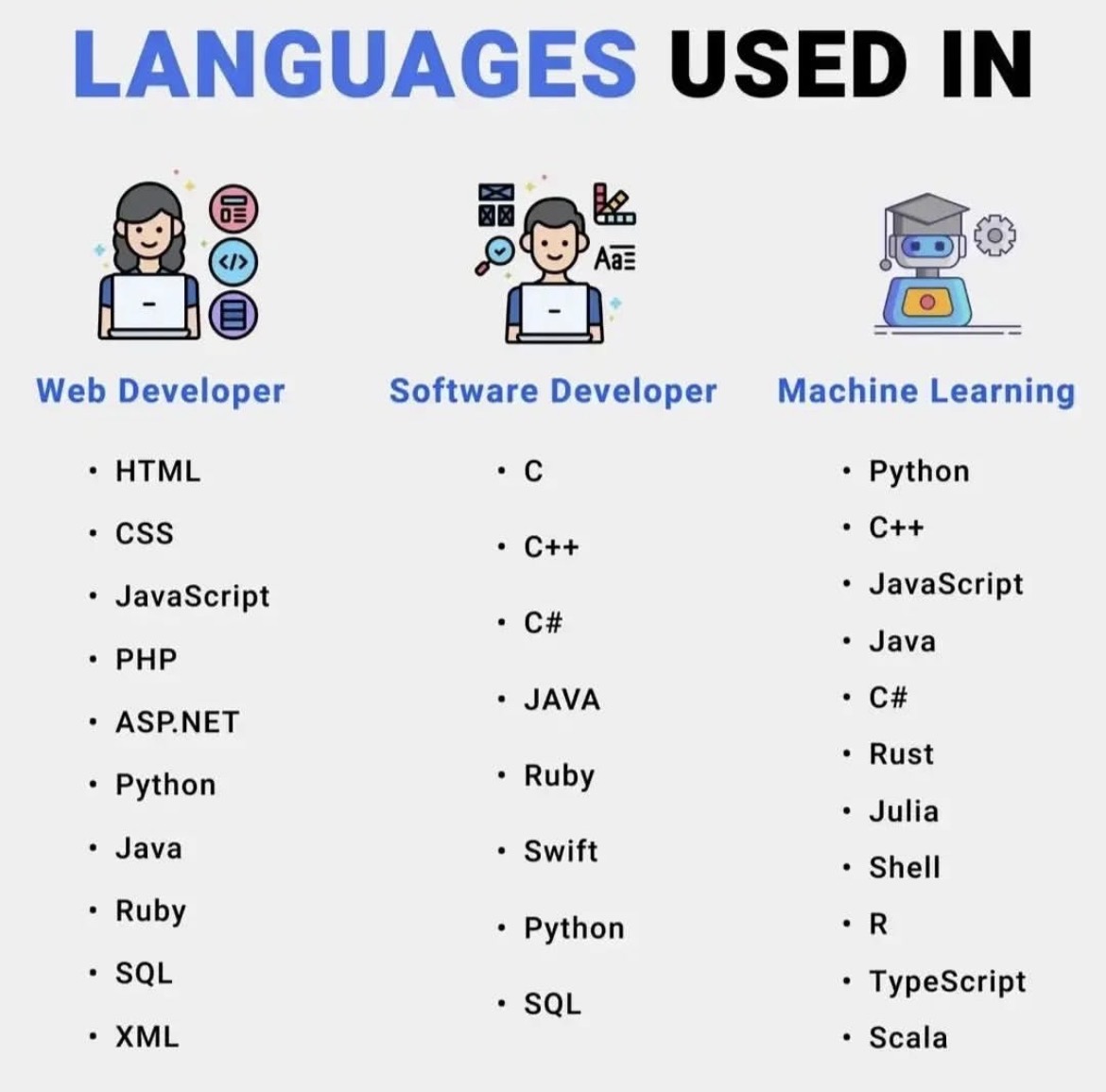
In this article, we’ll explore the most commonly used languages in web development, software development, and machine learning, and understand why each one is important.
🌐 Languages Used in Web Development
Web development focuses on building websites and web applications that run in browsers and on servers. A typical web developer works with both front-end (what users see) and back-end (server-side logic).
Key Languages for Web Developers
- HTML
HTML (HyperText Markup Language) forms the structure of every website. It defines elements like headings, paragraphs, images, links, lists, and other content, giving a page its basic layout. Without HTML, there would be no organized content for users to read or for browsers to display properly. Think of HTML as the skeleton of a webpage, providing the framework that supports all other elements, including styling and interactivity.
In practice, HTML works together with CSS and JavaScript to create fully functional websites. While HTML lays out the content, CSS controls the visual design, and JavaScript adds dynamic behavior. For example, a form uses HTML to define input fields and buttons, CSS to style them, and JavaScript to validate user input or trigger actions. Proper HTML structure also helps search engines understand and index the content, making it essential for SEO and overall website accessibility.
- CSS

CSS (Cascading Style Sheets) controls the design and layout of a website. It determines colors, fonts, spacing, positioning, and responsiveness, shaping how the content defined by HTML appears on different devices. If HTML is the skeleton of a webpage, CSS is the style and fashion, giving the site its visual identity and making it appealing and readable for users.
In real-world web development, CSS works alongside HTML and JavaScript to create fully functional, attractive websites. It allows developers to adjust layouts for desktops, tablets, and mobile devices, apply animations, and maintain consistent branding across pages. Proper use of CSS not only improves user experience but also supports accessibility and performance, making websites easier to navigate and more engaging for visitors.
- JavaScript
JavaScript makes websites interactive by allowing elements on a page to respond to user actions. It powers features like clickable buttons, animations, form validation, and real-time updates, bringing life to the content defined by HTML and styled with CSS. Without JavaScript, most websites would feel static, with limited functionality and no dynamic behavior.
In practical use, JavaScript works closely with HTML and CSS to create modern, engaging web experiences. For example, it can check a form for errors before submission, update content without reloading the page, or trigger animations when a user scrolls. By enabling these interactive features, JavaScript enhances user experience, keeps visitors engaged, and allows developers to build more responsive and functional websites.JavaScript makes websites interactive.
It allows features like:
• Buttons that respond to clicks
• Animations
• Form validation
• Real-time updates
Without JavaScript, most websites would feel static and boring.
- PHP

PHP is widely used for server-side web development, handling tasks that run on the server rather than in the user’s browser. It can process form submissions, manage databases, handle user authentication, and generate dynamic content that changes based on user actions. Many popular platforms, including WordPress, rely heavily on PHP to manage data, users, and website functionality behind the scenes.
In real-world applications, PHP works with HTML, CSS, and JavaScript to deliver complete websites. While HTML structures the content, CSS styles it, and JavaScript adds interactivity, PHP ensures that the content is dynamic and personalized, such as displaying a user’s profile, fetching posts from a database, or sending emails. Its ability to integrate with databases like MySQL makes PHP essential for building content management systems, e-commerce sites, and other data-driven websites.
- ASP.NET
ASP.NET is a Microsoft framework used for building powerful web applications and enterprise-level websites. It allows developers to create dynamic, scalable, and secure applications that can handle complex business logic and large amounts of data. ASP.NET is especially common in corporate environments and large systems where reliability, performance, and integration with other Microsoft technologies are important.
In practice, ASP.NET works with languages like C# or VB.NET to generate server-side content that interacts with databases, handles user input, and manages application workflows. Combined with HTML, CSS, and JavaScript on the front end, it enables developers to build fully functional websites and web applications that are responsive, secure, and capable of supporting large numbers of users and transactions efficiently.
- Python
Python is becoming increasingly popular in web development due to frameworks like Django and Flask, which make building robust web applications faster and more efficient. Its simple, readable syntax and powerful libraries allow developers to handle backend tasks such as database management, user authentication, and server-side logic with ease. Python’s versatility also makes it suitable for integrating APIs, data processing, and other advanced functionality.
In real-world web development, Python works on the server side to generate dynamic content, process user requests, and communicate with databases. When combined with HTML, CSS, and JavaScript on the front end, Python frameworks enable developers to build full-featured websites and applications that are scalable, maintainable, and secure. Its growing popularity is fueled by the balance it strikes between simplicity and power, making it a favorite among both beginners and experienced developers.
- Java
Java is widely used in enterprise-level web systems and large-scale applications that demand stability, security, and high performance. Its strong type system, robust libraries, and platform independence make it ideal for building complex backend systems, handling large volumes of data, and supporting critical business operations. Many banks, corporations, and large organizations rely on Java for their web infrastructure because of its reliability and scalability.
In practical web development, Java works on the server side to process requests, manage databases, and generate dynamic content for users. Frameworks like Spring and Java EE allow developers to create secure, modular, and maintainable applications, which integrate seamlessly with front-end technologies like HTML, CSS, and JavaScript. By combining these tools, Java enables the creation of enterprise-grade websites and applications that can handle heavy traffic while maintaining consistent performance and security.
- Ruby
Ruby, especially when used with the Ruby on Rails framework, allows developers to build web applications quickly and efficiently. Its elegant, readable syntax encourages clean code and rapid development, making it easier to maintain and scale projects over time. Ruby on Rails provides built-in tools for common tasks like database management, routing, and user authentication, which speeds up development and reduces repetitive work.
In real-world web development, Ruby on Rails powers dynamic websites and applications by handling backend logic, database interactions, and server-side processing. When combined with HTML, CSS, and JavaScript on the front end, it enables developers to create full-featured, interactive web apps with minimal boilerplate code. Its focus on convention over configuration and developer productivity makes Ruby a popular choice for startups and projects that need to launch quickly without sacrificing maintainability.
- SQL
SQL (Structured Query Language) is used to manage databases, allowing websites and applications to store, organize, and retrieve information efficiently. It handles data such as user accounts, products, transactions, and other critical content, making it essential for dynamic websites that rely on constantly changing information. SQL ensures that data can be accessed, updated, and managed securely and accurately.
In real-world web development, SQL works on the backend alongside server-side languages like PHP, Python, or Java to interact with databases. For example, when a user logs in, SQL queries fetch their account details; when a product is added to a shopping cart, SQL updates the inventory. By providing structured, reliable access to data, SQL enables websites and applications to function smoothly, handle large volumes of information, and deliver personalized experiences to users.
- XML
XML (eXtensible Markup Language) is used for storing and transporting structured data between systems and web services. It provides a standardized format that is both human-readable and machine-readable, making it ideal for exchanging information across different platforms, applications, and devices. XML allows developers to define custom tags and organize data hierarchically, ensuring that complex information can be transmitted and understood consistently.
In real-world web development, XML is often used in APIs, configuration files, and data feeds to transfer information such as product catalogs, user settings, or transactional data. While modern alternatives like JSON are increasingly popular, XML remains important in enterprise systems and legacy applications where structured, platform-independent data exchange is required. Its ability to maintain clear data structure and compatibility makes it a reliable tool for integrating disparate systems and services.
⸻
💻 Languages Used in Software Development
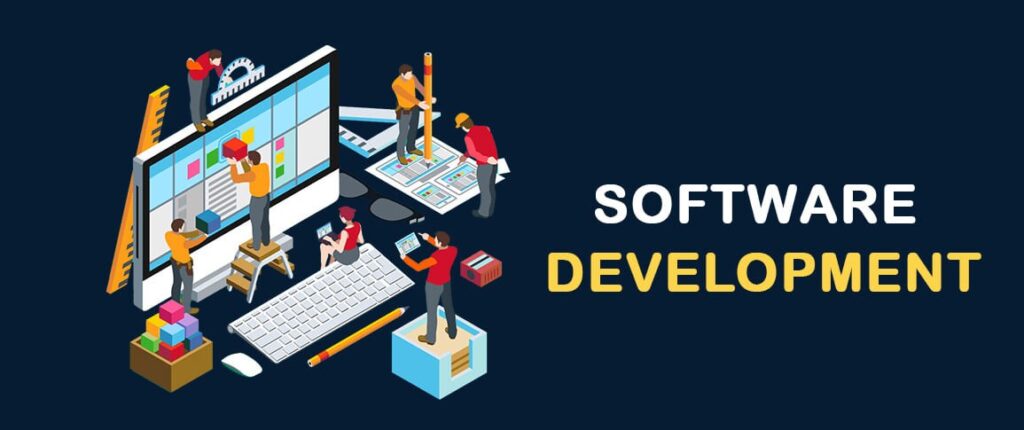
Software development involves creating desktop apps, mobile apps, and system-level software.
Core Software Development Languages
- C
C is one of the oldest and most influential programming languages, first developed in the early 1970s. Despite its age, it remains extremely powerful because it allows developers to work very close to the hardware while still providing structured programming features. Its efficiency, speed, and control over system resources make it a foundation for many modern languages like C++, Java, and even Python in some low-level modules.
In real-world applications, C is widely used for system programming, including operating systems like Linux and Windows, where it manages core functions such as memory allocation, process scheduling, and device communication. It is also a favorite for embedded systems, powering devices like routers, smart home appliances, medical instruments, and even automotive control systems. Because of its reliability and performance, C continues to be a critical language in industries where efficiency and precision are essential.
- C++
C++ builds on the C programming language and extends it by adding object-oriented features such as classes, inheritance, and polymorphism, which allow developers to write more structured and reusable code. At the same time, C++ still gives low-level control over memory and system resources, making it both powerful and efficient. This combination of high-level design and low-level performance is what makes C++ one of the most versatile programming languages in the world.
In real-world applications, C++ is widely used in game development, high-performance software, and system-level programming. Popular game engines like Unreal Engine are written in C++, and many AAA games rely on it for graphics, physics, and real-time performance. C++ is also used to build operating systems, web browsers, databases, and financial trading systems where speed and resource efficiency are critical. For example, parts of Windows, Linux, Google Chrome, and even Python itself are implemented using C++.
- C#
C# is a programming language developed by Microsoft and is mainly used for building applications within the Windows ecosystem and beyond. It is commonly used to create Windows desktop applications, web applications using the .NET framework, and large enterprise systems that require strong performance, security, and scalability. Because C# integrates deeply with Microsoft technologies, it is a popular choice for companies that rely on Windows servers and cloud services like Azure.
In real-world use, C# is also one of the leading languages for game development through the Unity game engine, which is used to build popular games for PC, mobile, consoles, and even virtual reality. Many business applications, such as accounting systems, hospital management software, and corporate tools, are built with C# because it offers a good balance between ease of development and powerful features for handling complex logic and large user bases.
- Java
Java is known for its reliability and strong cross-platform compatibility, which means code written in Java can run on different operating systems without major changes. This is possible because Java runs on the Java Virtual Machine (JVM), allowing developers to follow the principle of “write once, run anywhere.” As a result, Java is widely used in large-scale systems where stability, performance, and long-term support are critical.
In real-world applications, Java powers Android apps, enterprise software, and many global banking and financial systems. Most Android applications are built using Java or Java-based technologies, while companies use Java to develop backend services, payment platforms, and cloud-based systems. Major organizations like banks, airlines, and e-commerce platforms rely on Java to process millions of transactions daily, handle secure user data, and ensure their systems remain reliable under heavy traffic.
- Ruby
Ruby is appreciated for its simplicity and developer-friendly syntax, which makes it easy to learn and enjoyable to work with, especially for beginners and small development teams. The language was designed to focus on developer productivity, so many complex tasks can be written in fewer lines of code compared to other languages. This is one of the reasons many startups choose Ruby, as it allows them to build and update applications quickly without sacrificing code readability or maintainability.
In real-world backend development, Ruby is most commonly used with the Ruby on Rails framework. Popular platforms like GitHub and Shopify use Ruby on Rails to handle core features such as user accounts, authentication, product management, payments, and APIs. On the frontend side, Ruby helps generate dynamic web pages by rendering HTML on the server before sending it to the browser, making it possible to build full-stack applications where Ruby manages both the business logic and the user interface flow.
- Swift
Swift is a modern programming language developed by Apple and officially introduced in 2014 as a replacement for Objective-C. It is primarily used for building applications across Apple’s ecosystem, including iPhones, iPads, Macs, Apple Watch, and Apple TV. One of Swift’s biggest advantages is that it is designed to be fast, safe, and easy to read, making it a popular choice for both beginners and professional developers.
To develop apps using Swift, you need a Mac computer because Apple’s official development environment, Xcode, only runs on macOS. Xcode is an integrated development environment (IDE) provided by Apple that includes everything needed to build apps, such as a code editor, interface builder, simulator for testing apps on virtual devices, and powerful debugging tools. Swift also supports modern features like automatic memory management, strong type safety, and real-time error checking, which help developers catch mistakes early and write more reliable software.
An interesting fact many people don’t know is that Swift is open-source, meaning developers can use it outside Apple platforms too, such as for building server-side applications with frameworks like Vapor. However, its strongest and most common use is still native Apple app development, where it offers the best performance and full access to Apple’s latest APIs and features
- Python
Python is also widely used in software development, especially for automation, internal tools, and desktop applications. Because of its simple and readable syntax, Python allows developers to write programs quickly, which makes it ideal for automating repetitive tasks such as file management, data processing, system monitoring, and testing workflows.
In addition, Python is often used to build desktop applications using frameworks like Tkinter, PyQt, and Kivy, which make it possible to create graphical user interfaces (GUIs) for Windows, macOS, and Linux. Many popular software tools and platforms rely on Python behind the scenes, including parts of YouTube, Instagram, Dropbox, and Spotify. Another lesser-known fact is that Python is frequently used as a “glue language,” meaning it connects different systems, APIs, and services together, helping companies integrate software faster without rewriting everything from scratch.
- SQL
SQL also (Structured Query Language) is essential for handling data storage in software applications because it is the standard language used to communicate with relational databases. It allows developers to create, read, update, and delete data, which are the core operations behind almost every digital system, from simple websites to large enterprise platforms. Without SQL, applications would not be able to store user accounts, process transactions, manage content, or retrieve information efficiently.
In the backend of most systems, SQL works behind the scenes as the main way the application interacts with its database. For example, when a user logs into a website, the backend sends an SQL query to check the username and password stored in the database. When someone places an order on an e-commerce site, SQL is used to save the order details, update stock levels, and generate invoices. Backend technologies like Node.js, PHP, Python (Django, Flask), Java (Spring), and .NET all rely on SQL queries to fetch and manipulate data.
A lesser-known but important fact is that SQL also plays a major role in performance and security. Well-written SQL queries can make applications much faster by reducing load times and server costs, while poorly written queries can slow down entire systems. SQL is also used to define user permissions, meaning it controls who can access, modify, or delete sensitive data, which is critical for systems like banking apps, hospital records, and government platforms. In short, SQL is the backbone of backend data management in almost all modern software systems.
⸻
🤖 Languages Used in Machine Learning

Machine learning focuses on building intelligent systems that can learn from data and make decisions.
Popular Machine Learning Languages
- Python
Python dominates machine learning because of its simplicity, readability, and powerful libraries like TensorFlow, PyTorch, and scikit-learn. These tools make it easy to build, train, and deploy machine learning and AI models, from image recognition to natural language processing. Its large community and extensive documentation also help developers solve problems quickly and efficiently.
In real-world applications, Python is used across industries for predictive analytics, recommendation systems, autonomous vehicles, and AI-powered chatbots. It handles data processing, model training, and integration with web and mobile applications, making it the go-to language for both research and production in artificial intelligence and machine learning.
- C++
C++ is used in machine learning and AI when performance and speed are critical, particularly in production environments that require low-latency computations. Its efficiency and control over memory management make it ideal for implementing resource-intensive algorithms, optimizing model inference, and powering high-performance applications like computer vision, robotics, and real-time simulations.
In real-world AI systems, C++ is often used to build the core components of frameworks like TensorFlow or PyTorch, or in scenarios where models need to run on devices with limited resources, such as embedded systems or autonomous vehicles. By combining speed with precision, C++ ensures that machine learning applications can process large datasets and perform complex calculations quickly and reliably.
- JavaScript
JavaScript enables machine learning models to run directly in the browser using libraries like TensorFlow.js. This allows developers to build interactive AI applications that don’t require server-side processing, making it possible to perform tasks like image recognition, natural language processing, or predictive analytics entirely on the client side.
In real-world use, JavaScript-based machine learning is applied to web apps, browser games, and interactive dashboards where real-time inference is needed without sending data to a server. This approach improves privacy, reduces server load, and allows users to experience AI features instantly, all while leveraging the accessibility and ubiquity of the web.
- Java
Java is widely used in machine learning and AI for building enterprise-grade applications where stability, scalability, and performance are crucial. Its strong type system, portability, and mature ecosystem make it ideal for deploying machine learning models in production environments, especially when handling large volumes of data or integrating with existing corporate systems.
In real-world applications, Java is used to create backend services that run machine learning models, process big data with frameworks like Apache Spark, and support real-time analytics or recommendation engines. Its ability to deliver reliable, high-performance solutions makes it a preferred choice for large-scale AI systems in finance, e-commerce, and other enterprise sectors.
- C#
C# is a modern, versatile programming language developed by Microsoft as part of its .NET ecosystem. It combines the power of object-oriented programming with an easy-to-read syntax, making it ideal for building a wide range of applications. C# is especially strong for Windows-based development, allowing developers to create desktop applications, web services, and cloud-based solutions that integrate seamlessly with Microsoft tools and platforms. Its robust type system and built-in memory management also make it reliable for large-scale projects.
In real-world applications, C# is widely used for Windows desktop software, enterprise systems, and web applications built on ASP.NET. It’s also one of the leading languages for game development using the Unity engine, powering popular games on PC, mobile, and consoles. Beyond games, C# is used in industries like finance, healthcare, and logistics to build scalable, secure systems that handle complex business logic and large volumes of data efficiently.
- Rust
Rust is gaining popularity in machine learning for building high-performance and memory-safe systems. Its strong emphasis on safety and concurrency ensures that applications run efficiently without common issues like memory leaks or race conditions, making it ideal for resource-intensive AI workloads.
In practice, Rust is used for developing machine learning libraries, real-time data processing systems, and performance-critical components of AI applications. Its combination of speed, safety, and modern tooling allows developers to create reliable machine learning solutions that can handle large datasets and complex computations while minimizing runtime errors and improving overall system stability.
- Julia

Julia is designed for scientific computing and high-speed numerical analysis, making it well-suited for machine learning and data-intensive applications. Its syntax is simple and expressive, while its performance approaches that of low-level languages like C, allowing developers to run complex computations efficiently.
In real-world machine learning, Julia is used for tasks like numerical simulations, algorithm development, and large-scale data analysis. Its ability to handle high-performance calculations and work seamlessly with mathematical and statistical libraries makes it popular in research, finance, engineering, and AI projects that require fast, accurate computation.
- Shell
Shell scripting is used to automate machine learning workflows and manage data pipelines efficiently. By writing scripts for tasks like data preprocessing, model training, deployment, and system maintenance, developers can save time, reduce errors, and ensure processes run consistently.
In practical applications, shell scripts are often used to schedule training jobs, move or clean datasets, trigger model evaluations, and deploy models to servers or cloud environments. Automation through shell scripting ensures that machine learning pipelines are reliable, repeatable, and easier to maintain, especially when handling large datasets or complex workflows.
- R
R is widely used in machine learning for statistics, data analysis, and visualization. Its rich set of packages and built-in functions make it easy to explore data, perform statistical modeling, and create detailed visualizations to understand patterns and trends. This makes R especially valuable for research, academic projects, and data-driven decision-making.
In real-world applications, R is used to analyze datasets, build predictive models, and generate charts or dashboards that help interpret machine learning results. Its focus on statistical accuracy and visualization makes it a popular choice in healthcare, finance, social sciences, and any field that relies heavily on data insights.
- TypeScript
Java is often used alongside JavaScript frameworks to build scalable, machine learning–powered web applications. While Java handles the backend processing, data management, and model deployment, JavaScript frameworks manage the frontend, enabling interactive interfaces and real-time user experiences.
In real-world scenarios, this combination is used to create applications like recommendation engines, analytics dashboards, and AI-driven web services. Java ensures reliable performance and scalability on the server side, while JavaScript delivers dynamic, responsive interfaces in the browser, allowing machine learning models to serve users efficiently and at scale.
- Scala

Scala is often used with big data tools like Apache Spark for building large-scale machine learning systems. Its functional programming features and seamless integration with Spark make it ideal for processing massive datasets, performing distributed computations, and developing scalable ML pipelines.
In real-world applications, Scala with Spark is used for tasks like real-time analytics, recommendation engines, predictive modeling, and fraud detection. By combining Scala’s performance and expressiveness with Spark’s distributed computing power, organizations can efficiently handle complex machine learning workflows and deliver fast, reliable insights from large volumes of data.
⸻
🧠 Final Thoughts
Every programming field has its own set of important languages:
Field Main Focus Key Languages
Web Development Websites & web apps HTML, CSS, JavaScript, PHP, Python
Software Development Apps & systems C, C++, Java, C#, Swift
Machine Learning AI & data models Python, R, Java, Julia
You don’t need to learn everything at once.
Start with one path and grow step by step.
If you love website development → Start with HTML, CSS, JavaScript
If you love apps → Learn Python, Java, or C#
If you love AI → Focus on Python first
The tech world rewards consistency.
Pick a path, stay curious, and keep building.
Leave a Reply